JUNE AT CLUNY
June is another glorious month at Cluny with many flowers in bloom, gorgeous scents, busy insects and hungry young birds. Take your time going around looking up as well as down!
FOR A 2026 CLUNY SEED LIST, PLEASE LEAVE YOUR EMAIL OR NAME & ADDRESS. IT WILL BE AVAILABLE IN EARLY DECEMBER
PRIMULAS
Candelabra primulas continue to flower throughout June with the early species, Primula chungensis (yellow), P. pulverulenta (cerise) being replaced by P japonica (crimson or white), P. beesiana (purple) and P. bulleyana (orange). Drifts of the later species can be found growing in the bottom half of the garden in boggy or damp conditions. Other primulas in flower during June include P. alpicola, sikkimensis & florindae (Himalayan cowslip). On still days you can get a whiff of the delicate scents coming from all these lovely plants but the combination of colours is spectacular.
MECONOPSIS & PLANTS IN POTS
Tall, blue or white Himalayan poppies, Meconopsis baileyi are in flower in a number of areas in the garden. These and other similar species thrive in the humus-rich, moist soils of Cluny. On the gravel are pots (SORRY NOT FOR SALE!) showing examples of Meconopsis and many other plants growing in the garden. Younger versions are often for sale on the plant stall. Another interesting and unusual species is the shade and damp loving yellow Meconopsis chelidonifolia with long stems seen growing within the bamboo supports.
TREES & SHRUBS
Strongly scented azaleas, a few rhododendrons and Enkianthius are still in flower in early June. Many different highly scented shrub roses, Philadelphus (Mock orange), Deutzias, Syringa (lilac) and cotoneasters attract hundreds of worker bumblebees and wasps. Climbing clematis and honeysuckles can be found throughout. Around No 11 you will walk under the spectacular “Handkerchief tree” Davidia involucrata with its amazing creamy white bracts shimmering in the breeze. (You can also view the top of the tree looking left and down from the fallen Noble Fir at the end of the walk.) At No 19 Cornus kousa is a small tree which produces white bracts. There is another slightly further on, on the LHS. Just before No 24 (look behind and up) on the LHS is a Fragrant Snowbell Tree Styrax.
BULBS & TUBERS
This is the beginning of the lily season. One of the most prolific at Cluny, having seeded itself throughout much of the garden is L. martagon, a European Turkscap lily with flowers in shades of purple and white. Along with yellow L. pyrenaicum both grow prolifically on the wildflower bank as you approach or leave Cluny. During the latter half of the month, succeeding in out-growing them all is the magnificent Cardiocrinum giganteum, the Giant Himalayan Lily, with its long thick stalks which can grow up to 3m high topped with white scented trumpet flowers. The woody seed heads from last year can also be seen. The not well-known but very attractive sky-blue flowers of Notholirion bulbiliferum bloom in the lawn beds and at the bottom of the garden.
ARISAEMA (Cobra lilies)
These are amongst some of the strangest looking tuberous plants having unusually shaped spathes pale green to purple-veined in colour, often ‘well-hidden’ beneath large glossy leaves. One of the largest with a very long ‘tongue’, is Arisaema propinquum. A number are now growing very close to the paths. Some species with club shape tongues are commonly known as “Jack in the Pulpit”. In general, they are spreading throughout, thriving in the soil conditions and woodland atmosphere of Cluny.
AND THE REST!
Early in the month, Geraniums, Astrantia, Aquilegias, Foxgloves, Thalictrums (meadow rue), Jacob’s Ladders and Rodgersias provide colour and ground cover. Gentiana lutea (yellow gentian) flowers with tall spikes in the gravel in front of the house. There are other interesting plants in the gravel including introduced natives such as Nottingham Catchfly and Small Scabious, attractive to bumblebees. Digitalis grandiflora a yellow species foxglove, blooms prolifically in the gravel and elsewhere in the garden. Tropaeolum speciosum (Chilean Flame flower) is now crawling over many of the taller plants in the garden and by mid-June, its scarlet flowers should be in bloom.
WILDLIFE
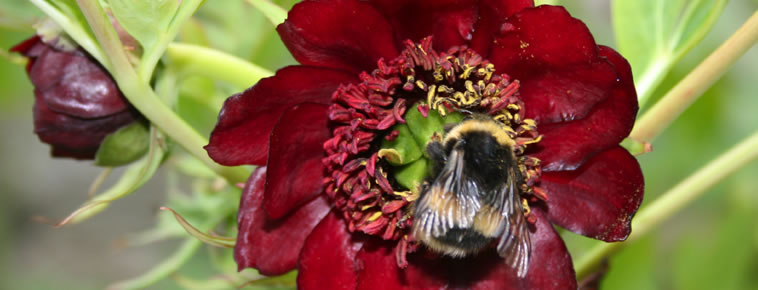
Sadly, the bird song quietens down by the middle of June but the woodland birds are very busy feeding their young including a pair of Great Spotted Woodpeckers. Look out for the Red Squirrels feeding at the bird feeders at the first ‘Big Tree’ (No 4 – 5). They can often be seen in other parts of the garden racing up and down the larger trees and on the feeders around the car park. On hot days they tend to be much less active feeding in the first part of the morning and late afternoon so don’t be surprised if you don’t see any around mid-day! There should be loads of insects in the garden especially bumblebees and wasps, all very beneficial in helping with pollination and in the case of wasps, protecting the plants by eating aphids. As long as the weather is fine there should be butterflies around including red admiral, green-veined white, speckled wood and comma. Apart from birds such as song thrush and blackbirds feeding on slugs, we also have plenty of toads and frogs and newts.
JUNE JOBS
In the garden: weeding, grass cutting and cutting back ….! Everything happens so quickly at this time of the year especially after the much welcome rain. Elsewhere seedlings continue to be pricked out and young plants potted on.