JULY AT CLUNY
PLEASE TAKE CARE OF CHILDREN. BE AWARE THERE ARE A NUMBER OF POISONOUS PLANTS IN THE GARDEN. IF YOU HAVE A DOG PLEASE KEEP IT ON A SHORT LEAD AT ALL TIMES, THANK YOU.
FOR A 2023 SEED LIST, PLEASE LEAVE YOUR EMAIL (PREFERABLY) OR NAME & ADDRESS IN ONE OF THE MONEY BOXES OR AT THE FRONT DOOR.
Remember to look out for Cluny’s RED squirrels anywhere in the garden although during the hottest part of the day, they may be having a snooze! A good place to watch for them is at No 5 where there is a seat for a comfortable watch!
The garden “grows” particularly well at this time of year especially as we have had some decent rain. Sadly, the main flowering season has passed and the garden is going into a green jungle phase, typical of a woodland garden.
BULBS & PRATIA PEDUNCULATA
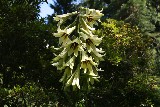
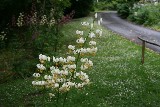
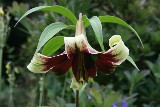
The tiny blue flower in the lawn grass is a Pratia, the blue star creeper. On entering the garden and in various other spots you will immediately notice the magnificent Cardiocrinum giganteum, the Giant Himalayan Lily, with its long thick stalks growing up to 3m high topped with pale green scented trumpet flowers. A few of last year’s seed heads can be seen still in position and resemble Venus Flytraps while the new seed pods look like green figs. One of the most prolific lilies at Cluny, having seeded itself throughout much of the garden is Lilium martagon, a European Turk’s-cap lily with flowers in shades of purple and white and flowers from late-June to early July followed by the familiar L lancifolium (Tiger Lily). The very beautiful Lilium nepalense with funnel shaped greenish yellow and maroon flowers appears in mid to late July in the first bed on the lawn. Lilium davidii an orange spotted large Turk’s-cap lily from western China also flowers in the lawn beds in mid to late July.
TROPAEOLUM SPECIOSUM
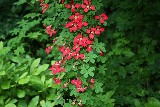
Related to nasturtium, the magnificent Tropaeolum speciosum or Chilean Flame Flower grows in many different places crawling through and over shrubs and trees. It has long spurred scarlet flowers and towards the end of the month and into August, its purple-blue berries will begin appearing. It grows from long white underground tubers preferring an acidic soil and like clematis species should be planted in the shade but allowed to grow into the sun.
LATE FLOWERING PRIMULAS
In early July the later flowering primulas are mainly growing in a very boggy area around Nos 26 & 27. The area is dominated by yellow or red P florindae (Himalayan cowslip) along with P sikkimensis, P poissonii and later Candelabras interspersed with native self-seeded orchids.
PERENNIALS & ANNUALS
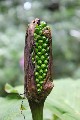
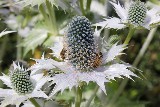
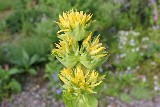
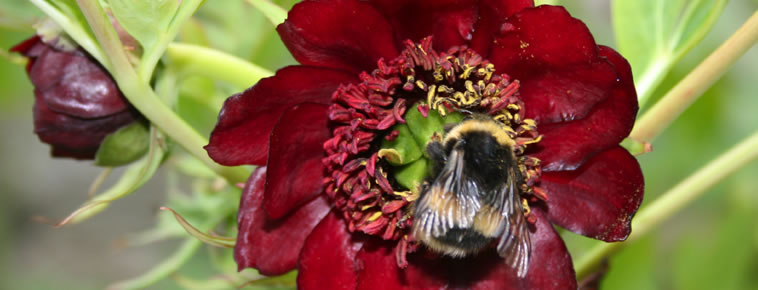
Ligularia (Golden Goundsel) is a tall yellow or orange daisy-like flower with large rounded leaves originating from central and eastern Asia. It grows throughout the garden but prefers a cool moist semi-shaded situation. Dotted around the top area of the garden and much loved by bees are the various very tall biennial yellow or white Verbascum species. Digitalis grandiflora is a lovely yellow medium sized perennial foxglove growing in the gravel and lawn beds. There are many self-seeded common foxgloves throughout the garden. Also, in the gravel are: Gentiana lutea (Bitterwort), a tall, yellow flowered perennial herbaceous gentian from the Pyrenees and Alps; Eryngium sp; many self-seeded orchids; and Scabiosa columbaria or small scabious much loved by bumblebees. The red berries of Actaea rubra (Baneberry) begin to colour later in July, as do those of its white form. There are large clumps of Actaeas around Nos 17 & 18 and throughout. The berries are very toxic to humans but much loved by bullfinches and therefore may not remain for long! The yellow climbing Meconopsis chelidoniflia from Western China is present throughout. Look out for the spectacular seed heads of Arisaema (Cobra lilies) turning from green tightly packed to lovely red and eventually mushy berries. The blue nettle-leaved campanula, an attractive introduced wildflower, has spread to various spots.
TREES & SHRUBS
At the entrance gate is a fine example of the beautiful Japanese Golden Acer Acer shirasawanum ‘Aureum’ (the Golden Leaf Full Moon Japanese Maple). This is the first Acer to show autumn tinges even in July. The hips on Rosa omeiensis also begin to colour up orange just after No 2 and opposite there in the gravel (red and orange). Towards the middle of the month, the cherries on the beautiful red-barked Tibetan cherry trees Prunus serrula tibetica (especially at No 10), will begin to ripen and become a favourite food for the many blackbirds and wood pigeons in the garden. Early in July a number of different types of shrubs flower throughout the garden including the highly scented Philadelphus (mock orange), Deutzia, Roses and Hypericum another bumblebee favourite. Crawling over some of the shrubs especially in the top area of the garden, is Codonopsis, a trailing creeper from the Himalayas, with many, usually green beautiful but not noticeable, tubular flowers. Wasps get drunk on their nectar! In early July at No 19 look out for Cornus kousa, a small tree with white bracts which are actually adapted leaves used to protect the flowers. Recently uncovered slightly further on at No 20 is a second very noticeable specimen. Between 24 & 25 above and to the left of the seat is very large specimen of a tree Hydrangea growing close to a Dawn Redwood, Metasequoia glptostroboides with a very convoluted bark.
WILDLIFE
If you are careful and quiet, you should see one of a number of Red Squirrels particularly if you visit when the garden first opens in the morning or later in the afternoon. They feed on hazelnuts and peanuts in feeders at the first Sequioadendron (No 5) but can be seen within the garden as well. It seems to have been an average breeding season for smaller bird species although we have a good number of house sparrows for a change! There are Great Spotted woodpecker and jay families along with bullfinches, long-tailed tits, song thrushes, goldcrests and treecreepers. There are plenty toads and frogs hopefully helping to consume lots of slugs! Bumblebees and wasps are very busy especially around the gravel area. In good weather there are butterflies including speckled wood, red admiral, large white, green-veined white, peacock and comma.
JULY JOBS
Seed collecting has begun and will continue into November. (Please resist from stealing any fresh seed, thank you! We, the garden and the wildlife need it all.) Weeding carries on as ever and cleared areas are mulched with our own compost or leaf mould. Constant cutting back of shrubs and trees is always necessary.