APRIL AT CLUNY
BULBS
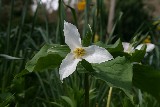
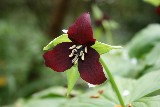
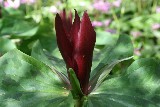
During April many species of American woodland bulbs can be seen flowering throughout the garden. There are approximately 18 varieties of white or maroon Trillium (Wake Robin, Wood Lily) throughout the garden. They are easily recognised by their 3 leaves, sepals and petals. The graceful nodding white, yellow or pink flowers of Erythronium (Dog’s Tooth Violet, Trout Lily) are gradually spreading over the woodland floor and paths! There are lots of varieties of Daffodils, Fritillaries, Scillas, and Chionodoxas along with a clump of Anemone blanda near No 10. Wild Wood Anemones appear throughout the garden especially where the ground is less disturbed. Large stalks of last year’s Cardiocrinum giganteum (giant Himalayan Lily) which flowered in June/July can still be seen. Their glossy heart-shaped leaves are already bursting out of the bulbs.
SKUNK CABBAGE & ARISAEMA
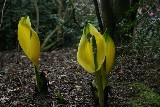
See if you can smell them before you see them! The spectacular large spathes of Lysichiton americanus (yellow) & L. camtschatcensis (white) are found in the wet areas of the garden. They are already growing huge green leaves which can reach as long as 1.5m. Another group of strange looking plants with a spathe rather than a flower are Arisaemas. They flower in May and June but A. nepenthoides aptly called, the cobra plant, from the Eastern Himalayas, will be through the ground in April.
MECONOPSIS
The first Meconopsis should begin to flower in the latter part of April. These are mainly the grandis hybrids with large beautiful electric or sky-blue flowers and are found in a number of beds in the garden. M x cookii a hybrid between M quintuplinerva and punicea, flowers with plum-pink drooping petals in one or two places in the garden but also in pots on the gravel close to the lawn. It has a preference for a sunny position and good humus-rich soil.
PRIMULAS
Cluny is famed for its Asiatic primulas. The pale pinky-blue P hoffmaniana, dotted around the garden has the unusual feature of propagating by runners with next year’s flowering plants on the end of each runner. Other Asiatic primulas include the rich purple P bracteosa, pinky purple P gracilipes and another carpeting primula, white P kisoana alba just past No 10 on the RH corner. There are drifts of the more common primulas such as oxlips, cowslips and even clumps of primroses, probably the most beautiful of them all. The first candelabra, the yellow P chungensis should appear by the end of the month shortly followed by the purple more robust P pulverulenta as well as naturally occurring hybrids between the two.
DENTARIA & GROUNDCOVER PLANTS
European woodland plants of Dentaria or Cardamine flower in tight, purple or cream clumps in several spots. They are excellent for the woodland garden. Throughout the top half of the garden there is good ground cover provided by Dicentra eximia, a graceful spreading plant with pink nodding flowers. In various hues of blues and with spotted leaves, are large swathes of Pulmonaria (Lungwort) around numbers 18, 19 and 20. In the wetter areas, mats of Chrysosplenium davidianum or David’s golden saxifrage have long-lasting yellow bracts and carpet the ground supressing weeds. Different species of long lasting Corydalis and small clumps of electric blue Hepatica nobilis (liver leaf) are dotted about adding even more colour and interest. The white, pink or red Hellebores have flowered well enough for a few weeks and will continue to be showy throughout much of April. A number have been eaten by mice or voles!
TREES AND SHRUBS
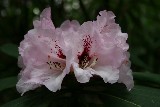
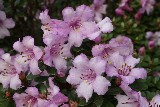
If there are no more hard frosts, the early rhododendrons should flower throughout the month. Look high to see their flowers for the best effect. Two good specimens of the colourful Pieris formosa are at No. 22 and between 29 & 30, busy with bumblebees! The first Magnolias and Prunus spp. (cherries) flower during April. It is still a good time of year, before most of the leaves come onto the trees, to appreciate the colour and texture of the various barks. One good example of this is the Tibetan Cherry, Prunus serrula tibetica with its red, peeling bark. The original plant in the garden can be seen at No 10. It is now over 60 years old, very shaggy, especially around the base, but redder and more polished in the younger stems closer to the top.
WILDLIFE
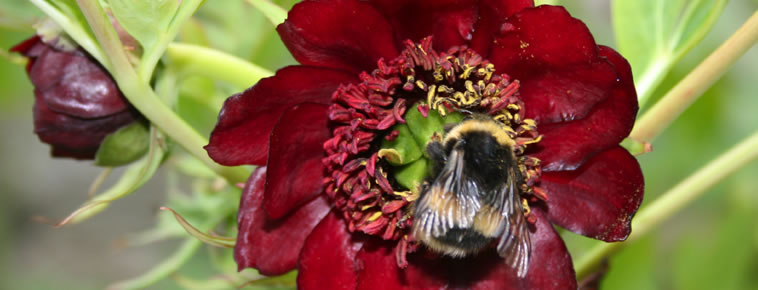
You should see one of our resident Red Squirrels without difficulty. They are given hazelnuts, peanuts and sunflower seed in feeders around the car park and at No5 at the first Sequioadendron (Big Tree). There are many birds on the various feeders including tits, siskins, chaffinches and goldfinches. Long-tailed tits, blackbirds, song and mistle thrushes, bullfinches, nuthatches and dunnocks are now busy nest prospecting and nest building. There are 2 great-spotted woodpecker territories around the garden and they are regularly heard drumming or giving loud “chattering” calls. Usually the first summer migrant to arrive in the 2nd week of April is the willow warbler although chiffchaff and blackcap can appear before then. There are stoats around generally in the top area of the garden but they are FAST. We have already had a number of bumblebees and honey bees feeding on early flowers. Comma butterflies should be seen on warm days around the lawn area. Frogs, toads and newts are all present but usually hiding! There are a number of nest boxes (and 6 bat boxes) throughout the garden to give the birds plenty of choices for nesting spots.
APRIL JOBS
Large quantities of our own leaf mould are spread over areas which have been recently weeded and tidied up. This acts as mulch and helps to suppress weeds. Spaces which have occurred over the winter are planted up with home-produced perennials and the occasional young tree. In the potting area, plants are being potted on for sale and seedlings pricked out.
If you see one of us working in the garden and you have any questions, we would be delighted to answer them, if we can. If you haven’t seen a squirrel please let us know.
Wendy, John, Fiona & Tom