OCTOBER AT CLUNY
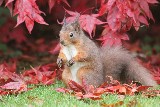
Autumn is a wonderfully colourful time with loads of berries, hips, seed-heads, cones, fungi and of course, a spectacular leaf change resulting in a myriad of hues and tints. Please take your time going round the garden making sure to follow the numbers 1 to 33. This is the time of year to LOOK UP and BEHIND you to see different views of colourful trees and shrubs and high cones. Remember to look out for the RED SQUIRRELS. They are always busy at this time of year.
TREES & SHRUBS
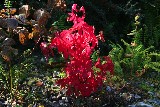
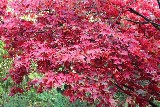
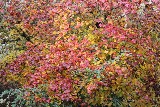
On the lawn and in the gravel in front of the house there are a number of fine examples of Acers or Japanese maples. In early to mid October these small trees appear to be on fire with wonderful orange and red hues. There are a number of other very colourful Acers throughout the garden and in the car park area. The pale green leaves of Aralia chinensis or Devil’s Walking Stick are some of the first to change to bright red and orange and very strangely, once the leaves drop, the plant flowers at the top of the stick. There is a large clump of Aralia behind the plant stall as well as around the edges of the lawn and within the garden. In the gravel are self-seeded “Himalayan Honeysuckles” with pendulous racemes of white flowers, red-purple bracts followed by deep purple berries. The berries are much loved by robins and bullfinches. Found throughout the garden, Enkianthus, Azaleas and Euonymus are 3 groups of large shrubs which have striking red, orange or yellow leaves as autumn progresses. Between 11 & 12, you should smell a burnt sugar scent from the yellow and pink leaves of the large Katsura Tree Cercidiphyllum japonicum, a very large tree on the LHS as you walk down the path. Particularly interesting are the different types of ‘lantern’ seed heads (some over-hanging the path) found on all the species of Euonymus. As they ripen, they open to reveal colourful tiny seeds again good food for robins. As the leaves fall, the colourful barks of different groups of trees such as the snake-bark maples, birches and cherries begin to stand out. It is also a wonderful feeling walking through freshly fallen leaves.
CREEPERS
The magnificent scarlet creeper crawling over and up trees and shrubs in the garden is Tropaeolum speciosum the ‘Flame Creeper’ from Chile. Although a few flowers remain, during October it is covered in blue berries. The plant grows from tubers and is herbaceous, dying back in the winter, growing from May onwards. Late white-flowered prolific Clematis can be seen growing on trees on the lawn. There are fluffy seed heads of other species Clematis throughout the garden and very attractive ones of C. tanguitica on the fence at the top corner as you leave.
BULBS & TUBERS
Although the spectacular Giant Himalayan Lily, Cardiocrinum giganteum, flowered in June, its green fig-like seed heads and stalks up to 3m high remain a structural feature especially around the top area of the garden. Some of last year’s “dead heads” also remain and appear very like Venus Flytraps. The seed will not viable for a number of weeks.
HIPS & BERRIES & CONES
Don’t miss the spectacular blue sausage fruit of Decaisnea fargesii (or blue bean shrub) between Nos 1 & 2. It originates from western China and Nepal and also has large colourful leaves. This is a good year for different types of berries including Cotoneaster, Hips & Berberis berries. There are various rowans including Sorbus hupehensis-pink berries, S. ‘Joseph Rock’- golden yellow berries, S. forrestii -white berries. There are other species of rowan and also cotoneasters with different coloured berries including black, glossy red and orange. There is a wide range of cones within the garden and you may see a number lying on the ground as well as on the trees. You will be surprised at the small size of the Sequoiadendron (the Redwood) cones found at Nos 5 & 9. Since Storm Arwen we have planted a number of young specimen trees particularly in the open space in the middle of the garden from No 12 onwards and in the area above No 29. Most are settling in very well.
HERBACEOUS PLANTS & CYCLAMEN
At the beginning of the month a few Chelone obliqua flowers remain. This is a late-flowering very attractive clump-forming plant growing to one metre with pink flowers shaped like a turtle head! There are clumps of a bright annual yellow “Busy Lizzie” particularly in the lawn area which will die right back with the first frosts but they have been flowering for many weeks. Also long flowered are the white Japanese anemones Anemone japonica. A large drift can be found at the bottom of the garden providing some food for the last of the summer’s hoverflies. The huge green leaves of Rodgersia spp. turn into yellows and oranges. Dainty Cyclamen flower in pink and white clumps throughout much of the garden.
WILDLIFE
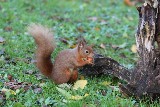
If you are quiet, you should easily see the Red Squirrels. They are regularly on the feeders but are also noticeable within the garden busy burying food or racing around the trees. Try stopping and just watching them. They may come very close. There has been a good crop of hazelnuts & fungi providing them with even more food. The garden is full of birds especially around the feeders – various tits, chaffinch, goldfinch, greenfinch, blackbird, robin, siskin and dunnock. Within the garden you could also see or hear bullfinch, treecreeper, wren, goldcrest, nuthatch, treecreeper, raucous jays and great spotted woodpecker or even a speedy sparrowhawk! Redwings and fieldfares should begin arriving early in October resulting in no more rowan berries. Geese (pinkfeet early in the month, mainly greylag thereafter) are regular overhead as well as buzzards and ravens. You might be lucky enough to see a stoat most likely in the area of No 5.
OCTOBER JOBS
There is still seed to collect; some will not be ready for picking until November. It has to be dried and cleaned ready for sowing or selling through our 2023 SEED LIST in mid-winter. If you would like a copy of the list, please leave your name and email address in one of the money boxes. We leave seed heads on many plants to allow a more natural type of germination in the garden. PLEASE do not steal seed. Weeding and mulching are still being done and we are preparing for the big winter jobs of leaf collection, tree extraction and path work. If you see one of us working in the garden and you have any questions, we would be delighted to answer them, if we can. WE HOPE YOU HAVE ENJOYED YOUR VISIT & WILL RETURN AGAIN. SIGNS OF SPRING ARE ALREADY HERE WITH EARLY BULBS PEEKING THROUGH!
John, Wendy & Fiona