MAY AT CLUNY
May is reckoned to be Cluny’s most glorious month with many plants in bloom along with fantastic scents, wonderful bird song and a terrific show of native bluebells. Cluny is a peaceful place so please take your time going around and enjoy the atmosphere and the Red Squirrels!
PRIMULAS
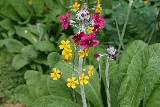
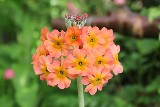
The first candelabra primulas flower from early May. The earliest is the orange-yellow P. chungensis but now the most prolific is the majestic purple P. pulverulenta along with naturally occurring hybrids of both primulas in orange, pink and pale purple. By the middle of the month P. japonica (crimson) and P. bulleyana (orange) and P. beesiana (purple) are beginning to appear. The best area to observe all the damp loving primulas is between nos. 28 & 29 in an area called ‘the bog’ which literally is as its name implies! The bog also provides a home for Trollius species, Royal Fern and many orchids.
BULBS & TUBERS
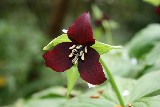
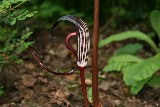
There are approximately 18 varieties of white, red or maroon Trilliums (Wake Robin, Wood Lily) in the garden easily recognised by their 3 leaves, 3 sepals and 3 petals. They take many years to reach the large clump sizes you will see here. Stalks of last year’s Cardiocrinum giganteum (giant Himalayan Lily) can still be seen with their Venus Flytrap-like seed heads. The fresh stalks of the bulbs to flower this year are already growing quickly and have noticeable glossy large heart-shaped leaves. They will flower towards the end of June. Ariseamas or Cobra lilies have their flowers hidden within strange-looking striped spathes and long “tongues” reach out to attract insects to aid fertilisation. A very large clump of Arisaema propinquum (Wallich’s Cobra lily) can be seen opposite the second Sequoiadendron between nos 9 & 10 flowering from mid-May.
MECONOPSIS - HIMALAYAN POPPIES
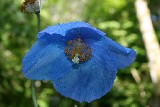
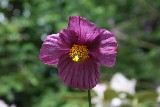
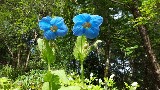
The larger flowered species borne on single stalks in rich blue is Meconopsis grandis or their hybrids. They are the first blue poppies to flower. M. baileyi with its beautiful smaller nodding heads in various hues of blue, and also pure white, grows in deep leaf mould throughout the garden later in the month. Early in May Meconopsis x cookei, in a bright plum colour, flowers mainly in pots on the gravel. There you will also see a selection of other Meconopsis.
CLEMATIS
From about mid-May, on the house wall (as you enter) and elsewhere in the garden, there is a white floriferous Chinese clematis similar to montana. Lovely pale blue Clematis macropetala from east and north Asia and light violet C. alpina from NW Eurasia can be seen generally draped over rhododendrons.
TREES & SHRUBS
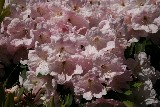
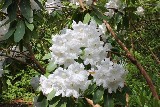
There are many gloriously scented ornamental apples and cherries all over the garden. Look out for Prunus serrula tibetica (Tibetan cherry) with its red peeling bark. Adding to the scents, are numerous lilacs (Syringa) and azaleas. Many rhododendrons & azaleas bloom in May along with the closely related Enkianthus, which bears pendant racemes of mainly pink bell-shaped flowers. The acers (Japanese Maples) with their beautiful fresh green leaves have small but delicate flowers while glorious Magnolias (M. wilsonii) overlooks the entrance panel) and Tree paeonias (P. delavayi) grow well in the shelter of the house. The striking climber Actinidia kolomitka with its variegated green white and pink leaves grows on the far end of the house wall. Towards the end of May the first hankies may be appearing on the spectacular Handkerchief tree – Davidia involucrata.
AND THE REST!
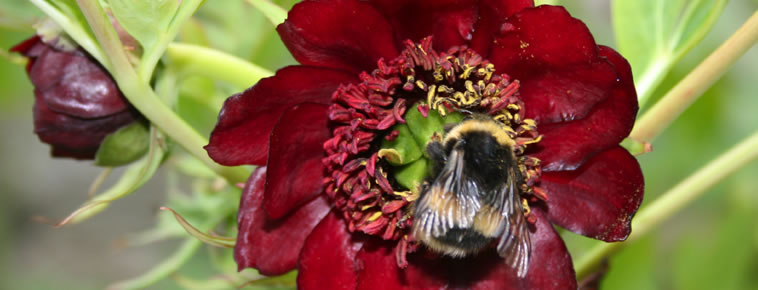
There are of course lots of other plants to enjoy but some favourites include Actaeas (Baneberry), Disporum smithii (Smith’s Fairybells), Thalictrum (meadow rue), highly scented Smilacina (false Solomon’s Seal) and many species and hybrid Aquilegia (Columbine, Granny’s Bonnet). Aquilegia flabellata is a particularly attractive blue and white low-growing species. Paeonia veitchii, a mauve single-flowered herbaceous perennial, grows around the woodland edge.
WILDLIFE
The birds are very busy singing, building nests and incubating eggs. Species like Mistle Thrush are already feeding young by early May. Migrant Blackcaps and resident Nuthatches fill the garden with their raucous voices while our resident swallows are forever “chattering” above the house! Look out for the Red Squirrels feeding at the bird feeders at the first ‘Big Tree’ (No 4 – 5) or around the car park area. They can often be seen in other parts of the garden racing up and down the larger trees. On warm days there are many insects including (hopefully!) a large population of bumblebees, all of them important for pollination of garden plants. Watch out for Bee flies Bombylius major. On sunny days they hover at great speed while dipping their long proboscis into flowers. We have already had a few orange-tip and peacock butterflies.
MAY JOBS
Pricking out seedlings and potting on are constant at this time of year. Weeding, as ever, continues but selectively, to try to keep a balance between wild flowers and garden plants. Ground cover plants such as Dicentra eximia, Chrysosplenium and the graceful foliage of Shuttlecock ferns lessen the weeding task as well as providing carpets of colour.